A couple of recent interviews about the themes of UK and EU security, going forward.
Europe_and_the_current_security_situation from Annie Machon on Vimeo.
And:
Post_Brexit_UK_EU_Security from Annie Machon on Vimeo.
A couple of recent interviews about the themes of UK and EU security, going forward.
Europe_and_the_current_security_situation from Annie Machon on Vimeo.
And:
Post_Brexit_UK_EU_Security from Annie Machon on Vimeo.
This article was first published on RT Op Ed a month ago.
The UK Ministry of Defence announced on 21 September the establishment of yet another British spy agency, an amalgam of military and security service professionals designed to wage cyber war against terrorists, Russia and organised crime. The new agency will have upwards of 2000 staff (the size MI5 was when I worked there in the 1990s, so not inconsiderable). I have been asked for a number of interviews about this and here are my thoughts in long form.
The UK already has a plethora of spy agencies:
To provide American context, MI6 equates to the CIA, GCHQ and the NCSC equate to the NSA, and the NCA to the FBI. Which rather begs the question of where exactly MI5 fits into the modern scheme – or is it just an anachronistic and undemocratic throw-back, a typically British historical muddle, or perhaps the UK’s very own Stasi?
So why the new and expensive agency at a time of national financial uncertainty?
Of course I acknowledge the fact that the UK deserves to retain a comprehensive and impressive defence capability, provided it is used for that purpose rather than illegal, needless wars based on spurious political reasons that cost innocent lives. Every country has the right and the need to protect itself, and the cybers are the newly-defined battle lines.
Moreover, it might be overly simplistic to suggest that this is just more empire-building on the part of the thrusting and ambitious young Secretary of State for Defence, Gavin Williamson. Perhaps he really does believe that the UK military needs augmenting after years of cuts, as the former Deputy Chairman of the UK Conservative Party and er, well-known military expert, Lord Ashcroft, wrote in the Daily Mail. But why a whole new intelligence agency at huge cost? Surely all the existing agencies should already be able to provide adequate defence?
Additionally, by singling out Russia as the hostile, aggressor state, when for years the West has also been bewailing Chinese/Iranian/North Korean et al hacking, smacks to me of political opportunism in the wake of “Russiagate”, the Skripals, and Russia’s successful intervention in Syria. Those of a cynical bent among us might see this as politically expedient to create the eternal Emmanuel Goldstein enemy to justify the ever-metastasising military-security complex. But, hey, that is a big tranche of the British, and potentially the post-Brexit, British economy.
The UK intelligence agencies are there to protect “national security and the economic well-being of the state”. So I do have some fundamental ethical and security concerns based on recent Western history. If the new organisation is to go on the cyber offensive what, precisely does that mean – war, unforeseen blow back, or what?
If we go by what the USA has been exposed as doing over the last couple of decades, partly from NSA whistleblowers including Bill Binney, Tom Drake and Edward Snowden, and partly from CIA and NSA leaks into the public domain, a cyber offensive capability involves stockpiling zero day hacks, back doors built into the internet monopolies, weaponised malware such as STUXNET (now out there, mutating in the wild), and the egregious breaking of national laws and international protocols.
To discuss these points in reverse order: among so many other revelations, in 2013 Edward Snowden revealed that GCHQ had cracked Belgacom, the Belgian national telecommunications network – that of an ally; he also revealed that the USA had spied on the German Chancellor’s private phone, as well as many other German officials and journalists; that GCHQ had been prostituting itself to the NSA to do dirty work on its behalf in return for $100 million; and that most big internet companies had colluded with allowing the NSA access to their networks via a programme called PRISM. Only last month, the EU also accused the UK of hacking the Brexit negotiations.
Last year Wikileaks reported on the Vault 7 disclosures – a cache of CIA cyber weapons it had been stockpiling. It is worth reading what Wikileaks had to say about this, analysising the full horror of how vulnerable such a stockpile makes “we, the people”, vulnerable to criminal hacking.
Also, two years ago a huge tranche of similarly hoarded NSA weapons was acquired by a criminal organisation called the Shadow Brokers, who initially tried to sell them on the dark web to the highest bidder but then released them into the wild. The catastrophic crash of NHS computers in the UK last year was because one of these cyber weapons, Wannacry, fell into the wrong criminal hands. How much more is out there, available to criminals and terrorists?
The last two examples will, I hope, expose just how vulnerable such caches of cyber weapons and vulnerabilities can be if not properly secured. And, as we have seen, even the most secret of organisations cannot guarantee this. To use the American vernacular, they can come back and bite you in the ass.
And the earlier NSA whistleblowers, including Bill Binney and Tom Drake, exposed just how easy it is for the spooks to manipulate national law to suit their own agenda, with warrant-less wiretapping, breaches of the US constitution, and massive and needless overspend on predatory snooping systems such as TRAILBLAZER.
Indeed, we had the same thing in the UK when Theresa May succeeded in finally ramming through the invidious Investigatory Powers Act (IPA 2016). When she presented it to parliament as Home Secretary, she implied that it was legalising what GCHQ has previously been doing illegally since 2001, and extend their powers to include bulk metadata hacking, bulk data set hacking and bulk hacking of all our computers and phones, all without meaningful government oversight.
Other countries such as Russia and China have passed similar surveillance legislation, claiming as a precedent the UK’s IPA as justification for what are claimed by the West to be egregious privacy crackdowns.
The remit of the UK spooks is to protect “national security” (whatever that means, as we still await a legal definition) and the economic well-being of the state. I have said this many times over the years – the UK intelligence community is already the most legally protected and least accountable of that of any other Western democracy. So, with all these agencies and all these draconian laws already at their disposal, I am somewhat perplexed about the perceived need for yet another costly intelligence organisation to go on the offensive. What do they want? Outright war?
First published by Consortium News.
Just after midnight on 16 August I was called by LBC in London for a comment on a breaking story on the front page of The Daily Telegraph about British spies hacking the EU. Even though I had just retired to bed, the story was just too irresistible, but a radio interview is always too short to do justice to such a convoluted tale. Here are some longer thoughts.
For those who cannot get past the Telegraph pay wall, the gist is that that the EU has accused the British intelligence agencies of hacking the EU’s side of the negotiations. Apparently some highly sensitive and negative slides about the British Prime Minister’s plan for Brexit, the Chequers Plan, had landed in the lap of the British government, which then lobbied the EU to suppress publication.
Of course, this could be a genuine leak from the Brussels sieve, as British sources are claiming (well, they would say that, wouldn’t they?). However, it is plausible that this is the work of the spies, either by recruiting a paid-up agent well-placed within the Brussels bureaucracy, or through electronic surveillance.
Before dismissing the latter option as conspiracy theory, the British spies do have form. In the run up to the Iraq war in 2003, the USA and UK were desperate to get a UN Security Council resolution to invade Iraq, thus providing a fig leaf of apparent legitimacy to the illegal war. However, some countries within the UN had their doubts and the USA asked Britain’s listening post, GCHQ, to step up its surveillance game. Forewarned is forearmed in delicate international negotiations.
How do we know this? A brave GCHQ whistleblower called Katherine Gun leaked the information to The Observer. For her pains, she was threatened with prosecution under the draconian terms of the UK’s 1989 Official Secrets Act, and faced two years in prison. The case was only dropped three weeks before her trial was due to begin, partly because of the feared public outcry, but mainly because her lawyers threatened to use the legal defence of “necessity” – a defence won only three years before during the case of MI5 whistleblower, David Shayler. Tangentially, a film is this year being made about Gun’s story.
We also have confirmation from one of the early 2013 Edward Snowden disclosures that GCHQ had hacked its way into the Belgacom network – the national telecommunications supplier in Belgium. Even back then there was an outcry from the EU bodies, worried that the UK (and by extension its closest intelligence buddy the USA), would gain leverage with stolen knowledge.
So, yes, it is perfectly feasible that the UK could have done this, even though it was illegal back in the day. GCHQ’s incestuous relationship with the America’s NSA gives it massively greater capabilities than other European intelligence agencies, and the EU knows this well, which is why is is concerned to retain access to the UK’s defence and security powers post-Brexit, and also why it has jumped to these conclusions about hacking.
But that was then and this is now. On 1st January 2017 the UK government finally signed a law called the Investigatory Powers Act, governing the legal framework for GCHQ to snoop. The IPA gave GCHQ the most draconian and invasive powers of any western democracy. Otherwise known in the British media as the “snoopers’ charter”, it had been defeated in Parliament for years, but Theresa May, then Home Secretary, pushed it through in the teeth of legal and civil society opposition. This year the High Court ordered the UK government to redraft the IPA as it is incompatible with European law.
The IPA legalised what GCHQ had previously been doing illegally post‑9/11, including bulk metadata collection, bulk data hacking, and bulk hacking of electronic devices.
It also notionally gave the government greater oversight of the spies’ actions, but these measures remain weak and offer no protection if the spies choose to keep quiet about what they are doing. So if GCHQ did indeed hack the EU, it is feasible that the Foreign Secretary and the Prime Minister remained ignorant of what was going on, despite being legally required to sign off on such operations. In which case the spies would be running amok.
It is also feasible that they were indeed fully briefed and an argument could be made that they would be correct to do so. GCHQ and the other spy agencies are required to protect “national security and the economic well-being” of Great Britain, and I can certainly see a strong argument could be made that they were doing precisely that, provided they had prior written permission for such a sensitive operation, if they tried to get advance intelligence about the EU’s Brexit strategy.
This argument becomes even more powerful when you consider the problems around the fraught issue of the border between Northern Ireland and Ireland, an issue about which the EU is being particularly intransigent. If a deal is not made then the 1998 Good Friday Agreement could be under threat and civil war might again break out in Northern Ireland. You cannot get much more “national security” than that and GCHQ would be justified in this work, provided it has acquired the necessary legal sign-offs from its political masters.
However, these arguments will do nothing to appease the enraged EU officials. No doubt the UK government will continue to state that this was a leak from a Brussels insider and oil will, publicly at least, be seen to have been poured on troubled diplomatic waters.
However, behind the scenes this will multiply the mutual suspicion,and will no doubt unleash a witch hunt through the corridors of EU power, with top civil servant Martin Selmayr (aka The Monster) cast as Witchfinder General. With him on your heels, you would have to be a very brave leaker, whistleblower, or even paid-up agent working for the Brits to take such a risk.
So, perhaps this is indeed a GCHQ hack. However justifiable this might be under the legally nebulous concept of “national security”, this will poison further the already toxic Brexit negotiations. As Angela Merkal famously if disengenously said after the Snowden revelation that the USA had hacked her mobile phone: “no spying among friends”. But perhaps this is an outdated concept – nor has the EU exactly been entirely friendly to Brexit Britain.
I am just waiting for the first hysterical claim that it was the Russians instead or, failing them, former Trump strategist-in-chief, Steve Bannon, reportedly currently on a mission to build a divisive Alt-Right Movement across Europe…..
First Published by Consortiumnews.com.
A few days ago I first received a menacing message from someone calling herself Susana Peritz, telling me that “she” had hacked my email, planted malware on my computer, and had then filmed me getting my jollies while watching “interesting” porn online. Her email had caught my attention because it had written in the subject line a very old password, attached to a very old email address I had not used for over a decade, and the malware must have been planted on a defunct computer.
Putting aside the fact that I am far more concerned about GCHQ or the NSA hacking my computer (as should we all be), this did rather amuse me.
Apparently, I must pay this “Susana” $1000 via Bitcoin or, shock, have my alleged pleasures shared with my acquaintances. And just last night I received another courteous request for cash from someone calling themselves Jillie Abdulrazak, but the price has now inflated to $3000.
Why am I not concerned? Well, I can safely say — hand on heart — that I have never watched online porn. But this got me thinking about how or why I could have been singled out for this mark of a blackmailer’s esteem, and that brings me on to some rather dark thoughts.
It is perfectly possible that a rare, unguarded moment of long-distance online love might have been captured (but by whom?). That would probably be over a decade ago and would certainly have been using the old email account which was attached to the particular password at the time.
However, even those memories have been denied me – I distinctly remember that I have been too paranoid for too long and have always covered the built-in computer camera lens. Anything that could possibly have been recorded could only be audio – a saucy phone call at most. There can be no video of my younger self, alas.
I have had good reason to be paranoid. In the late 1990s I supported my former partner and fellow MI5 intelligence officer, David Shalyer, in his whistleblower exploits to expose the crimes and incompetence of the UK spy agencies at the time.
This resulted in us literally going on the run across Europe, living in hiding for a year in la France profonde, and another two years in exile in Paris before he voluntarily returned to the UK in 2000 to face the music and inevitably, under the terms of the UK’ draconian 1989 Official Secrets Act, being sent to prison for exposing the crimes of British spies.From those years, knowing what we knew about the spies’ capabilities even then, the sense of being always potentially watched has never rubbed off.
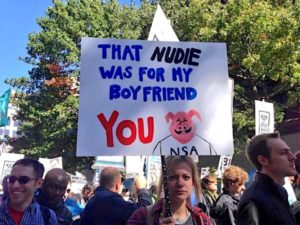 So, knowing absolutely that I have never watched any online porn and that I always keep my computer camera lens covered, “Susana” and “Jillie” can go whistle. You have tried to shake down the wrong paranoid ex-MI5 whistleblower, darlings. And my tech people are now hunting you.
Any possible audio could, I suppose, be spliced in some way to some dodgy video to make this the stuff of a blackmailer’s dreams. That, surely, will be easy to forensicate – and indeed I have other friends who can do this, at world class level.
Alternatively, the former love at the time could have recorded the audio for his own nefarious personal usage for some nebulous time in the future. And if that future is now, after he had shown himself a long time ago to be chronically dishonest, why do this in 2018 when we have been separated for years?
Or indeed, he may have continued to used the old email account himself to watch vile material – he certainly had the password back then and perhaps he uses it to distance himself from his own porn habit (fapware, as the geeks call it)? If that is the case, he is even less honourable than I had considered him to be.
Or perhaps this is some type of dark LoveInt operation by the spooks, in some failed attempt to frighten or embarrass me?
But there is, of course, a bigger, more political picture.
Ever since I worked as an intelligence officer for MI5, before going on the run with David Shayler during the whistleblowing years in the late 1990s, I have been painfully aware of the tech capabilities of the spies. Even back then we knew that computers could be captured by adversaries and turned against you – keystroke loggers, remote recording via microphones, cameras switched on to watch you, and many other horrors.
The whistleblowing of Edward Snowden back in 2013 has confirmed all this and more on an industrial, global scale – we are all potentially at risk of this particular invasion of our personal privacy. I have kept my computer and mobile camera lenses covered for all these years precisely because of this threat.
One specific Snowden disclosure, which has received little MSM traction, was a programme called OPTIC NERVE. This was a GCHQ programme (funded by American money) that allowed the spooks to intercept in real time video conferencing calls. It turned out, horror, that 10% of them were of a salacious nature, and the spooks were shocked!
I have spoken about privacy and surveillance at conferences around the world and have many, many times had to debate the supposition that “if you are doing nothing wrong, you have nothing to hide”.
However, most people would like to keep their intimate relationships private. In this era of work travel and long distance relationships, more of us might well have intimate conversations and even video play via the internet. In an adult, consensual and mutually pleasurable context, we are doing nothing wrong and we have nothing to hide, but we surely don’t want the spooks to be watching us or listening in, any more than we would want the criminals capturing images and trying to shake us down for money.
This low-level and amateur attempt at extortion is risible. Unfortunately, the threat from our governments spying on us all is not.
Here is an interview I gave to RT about the recent news that Facebook has tagged 65,000 Russians as interested in “treason”. Hardly helpful, but similar to the other snooping with algorithms they have done across the West into people’s supposed views, and not least the involvement with Cambridge Analytica.
Facebook implicated in more surveillance from Annie Machon on Vimeo.
First published by Consortium News.
On 5th June 2018 the UK Home Secretary, Sajid Javid, unveiled his new counter-terrorism initiative that he says is targeting an ever-metastasising threat, yet it raises a raft of new questions about people’s rights.
The government is acting on the imperative that something needs to be done. But MI5 — officially known as the UK domestic Security Service and the lead organisation in combating terrorism within the UK — has already, since the start of the war on terror, doubled in size and has also been promised yet more staff over the next two years.
Yet despite these boosted resources for MI5, as well as increased funding and surveillance powers for the entire UK intelligence community, virtually every terror attack carried out in the UK over the last few years has been committed by someone already known to the authorities. Indeed, the Manchester bomber, Salman Abedi, had been aggressively investigated but MI5 ignored vital intelligence and closed down the active investigation shortly before he carried out the attack.
This failure to target known threats is not just a UK problem. Attacks across Europe over the last few years have repeatedly been carried out by people already on the local security radar.
New approaches are needed. But this latest offering appears to be a medley of already failed initiatives and more worryingly a potentially dangerous blueprint for a techno-Stasi state.
The main points of the new Home Office plan include: making MI5 share intelligence on 20,000 “subjects of concern” with a wide range of organisations, including local councils, corporations, local police, social workers, and teachers; calling on internet companies to detect and eradicate extremist or suspicious content; making online marketplaces such as Amazon and eBay report suspicious purchases; increasing surveillance of big events and infrastructure; and passing even tougher anti-terrorism laws.
This all sounds reasonable to those who are fearful of random attacks on the streets or at events – that is unless one has seen in the past how some initiatives have already been proven to fail or can foresee in the future wholesale abuse of increased surveillance powers.
Intelligence is not Evidence
The most chilling part of the MI5 plan is sharing intelligence on 20,000 subjects of concern. First of all, this is intelligence – by nature gathered from a range of secret sources that MI5 would normally wish to protect. When communicating with counter-terrorism police, intelligence agencies will normally hide the source, but that will require an immense amount of work for 20,000 cases before the information can be shared. Secondly, bear in mind that intelligence is not evidence. Effectively MI5 will be circulating partially assessed suspicions, perhaps even rumours, about individuals, very widely about people who cannot be charged with any crime but who will fall under a deep shadow of suspicion within their communities.
Also if this intelligence is spread as widely as is currently being suggested, it will land in the laps of thousands of public bodies – for instance, schools, councils, social care organisations, and local police. Multiple problems could arise from this. There will no doubt be leaks and gossip within communities – so-and-so is being watched by MI5 and so on.
There will also be the inevitable mission-creep and abuse of power that we saw almost 20 years ago when a whole range of the same public bodies were allowed access to the new eavesdropping and surveillance law, the Regulation of Investigatory Powers Act (2000). Back then, local councils were abusing counter-terrorism legislation to catch people who might be trying to play school catchment areas (districts) to get their children into better schools, or even, and I kid you not, might be cockle-rustling on their local beach. Of course, such intrusive electronic surveillance powers have been significantly increased since then, with the Investigatory Powers Act 2017, that allows bulk storage, bulk dataset hacking and hacking per se.
All this follows the notorious Home Office counter-terrorism PREVENT scheme – the failed parent of these new proposals.
A decade ago PREVENT was designed to reach out, build bridges with Muslim communities across Britain, encouraging them to report any suspicious behaviour to the authorities to nip incipient radicalisation in the bud. Unfortunately it did not quite work out that way. Young Muslims told stories of pressure from MI5 to spy on their communities. It destroyed community trust rather than built it.
Unfortunately, this new Home Office scheme goes even further down the wrong path. It asks teachers, social workers, the local police and other authority figures to go beyond reporting suspicious behaviour to actually be given a list of names to keep a awatch on “subjects of interest”.
The last time such a system of community informants used in Europe was ended when the Berlin Wall came down in 1989 and East Germany’s Stasi system of a vast network of informers was revealed in all its horror. How ironic that the same system that was devised to protect the East German youth from the “decadent influence” of Western ideals is now being proposed in a “decadent” Western country to spy on its own youth for traces of radicalisation.
Corporate Allies
Suffice to say that if the British government cannot even make the internet titans such as Google and Facebook pay their fair share in taxes, nor call Facebook’s Mark Zuckerberg to account in Parliament about the Cambridge Analytica scandal, then good luck forcing them make a meaningful effort to root out extremist material.
But even if they do agree, this idea is fraught with the troublesome question of who gets to decide whether something is extremist material or a dissenting opinion against the establishment? Facebook, Google and Youtube are already engaging in what can only be called censorship by de-ranking in search results material from legitimate dissident websites that they, with no history of exercising news judgement, deem “fake news”.Such established news sites such as Wikileaks, ConsortiumNews and World Socialist Web Site as well as many others listed on the notorious and unreliable PropOrNot list have taken a significant hit since these restrictions came into play on 23 April 2017.
Amazon, eBay and other retail companies are being asked to report suspicious sales of precursor materials for bombs and other weapons. Car hire companies will be asked to report suspicious individuals hiring cars and lorries. Algorithms to detect weapons purchases may be feasible, but denying rentals to merely “suspicious” individuals who’ve committed no crimes strays into Stasi territory.
Back in the era of fertiliser lorry and nail bombs, laws were put in place across Europe to require fertiliser companies to report strange purchases – from people who were not registered agriculturalists, for example, Unfortunately, this law was easily subverted by Norwegian right-wing terrorist, Anders Breivik, who simply worked to establish a farm and then legally purchased the ingredients for his Oslo car bomb in 2011.
You are Being Watched
The UK is known as having the most CCTV cameras per capita in the Western world. There have been various plans mooted (some leaked to Wikileaks) to hook these up to corporations such as Facebook for immediate face tagging capabilities, and the development of algorithms that can identify suspicious behaviour in real time and the police can move to intercept the “suspect”.
Face recognition cameras are being trialled by three police forces in the UK – with software that can allegedly watch crowds at events and in stations and potentially identify known criminals and suspects in a crowd and alert the police who will immediately move in and intercept.
Unfortunately, according to Big Brother Watch in the UK, these computer systems have up to a 98% failure rate. If the Home Secretary is really suggesting that such dodgy software is going to be used to police our public spaces I would suggest that he ask his geeks to go back and do their homework.
Do we really want to live in a country where our every movement is watched by technology, with the police waiting to pounce; a country where if we are running late or are having a stressed work day and seem “strange” to a person in a car hire company, we can be tracked as a potential terrorist; where children need to fear that if they ask awkward, if interested, questions of their teachers or raise family concerns with social care, they might already be on a watch list and their file is stacking up slowly in the shadows?
That way lies totalitariansim. I have been tracking how a state can slide unthinkingly into such a situation for years, particularly looking at such warnings from history as 1930s Germany and, over the last decade, I have seriously begun to fear for my country.
If these measures go through Britons could be living under SS-GB – the name of a book by the excellent spy writer, Len Deighton, in his envisioning of what the UK would have been like if the Nazis had succeed in invading during World War Two. The ultimate irony is that the acronym attributed to MI5 at international intelligence conferences way back in the 1990s used to be UK SS – UK Security Service. I hear it has changed now….
The EU is trying to take steps to curb Bitcoin. Why? Here’s the long version:
https://www.rt.com/news/413517-bitcoin-cryptocurrency-eu-crackdown/
And the short:
Recently I was invited to be on the global council of a new tech policy intitiative called the Good Technology Collective, based in Berlin.
~ Founded by a group of technology enthusiasts led by 1aim co-founders Torben Friehe and Yann Leretaille, the GTC will serve as a crucial European forum for piloting technological advances in the 21st century. Through its Expert Council, it will bring together leading founders, engineers, scientists, journalists, and activists, who will research, generate conversation around, and offer counsel as to the societal impact of AI, virtual reality, Internet of Things, and data surveillance.
“We believe that there are ethical questions concerning how frontier technologies will affect our daily lives,” Leretaille said. “As a society, Europe deserves broad and accessible discussions of these issues, hosted by those who appreciate, understand, and worry about them the most.” ~
The Good Technology Collective (GTC), a new European think-tank addressing ethical issues in technology, will officially open its doors in Berlin on December 15th. The grand opening will kick off at 7:30PM (CET) at Soho House Berlin and I shall be one of the guest speakers.
Invitations are limited for the grand opening. Those interested in attending should contact: rsvp@goodtechnologycollective.com; or, fill in the invitation form at: https://goo.gl/Xpndjk.
And here is an introductory interview I did for GTC recently:
Why We Must Fight for Privacy
We live in a society where shadowy figures influence what makes the news, who goes to jail, and even who lives or dies.
We live in a system where corporations and the state work together to take control of our information, our communications, and potentially even our future digital souls.
So we do not merely have the right, but rather the obligation, to fight for our privacy.
It is a simple human right that is essential for a functioning democracy.
But we are a long way away from having that right guaranteed, and we have been for a long time.
My Time as a Spy
I spent six years working with MI5, the British domestic counter-intelligence and security agency, in the 1990s. It was a time of relative peace after the Cold War and before the horrors of September 11, 2001, when the gloves came off in the War on Terror.
And even then, I was horrified by what I saw.
There was a constant stream of illegal wiretaps and files kept on hundreds of thousands of our citizens, activists, journalists, and politicians.
Innocent people were sent to prison due to suppressed evidence in the 1994 bombing of the Israeli Embassy in London. IRA bombings that could have been prevented were allowed to take place, and the MI6 funded a plot to murder Libyan leader Colonel Gaddafi using Al Qaeda affiliates. He survived, others did not.
This is just part of the corruption I saw intelligence and security agencies engage in.
The public and many politicians believe these agencies are accountable to them, but that is simply not how things work in reality. More often than not, we only know what they want us to hear.
State Manipulates News and Politics
I witnessed government agencies manipulate the news through guile and charm, at times even writing it themselves. Fake news is not new. The state has long shaped media coverage using various methods.
This was the case in the analogue era, and things have become worse in the era of the Web.
In the end, I felt there was no choice but to blow the whistle, knowing that it would end my career. My partner and I resigned, and we went into hiding.
We spent years on the run for breaching the UK Official Secrets Act. We would have been imprisoned if caught.
We fled Britain in 1997, spending three years in a French farmhouse and a location in Paris. My partner went to prison, twice, and we learned indelible lessons about state power along the way.
Learning the Value of Privacy
We also learned the value of privacy.
As high-value targets, we knew our communications and relatives were monitored.
So when I called or emailed my mother, I had to self-censor. I had to assume that her house was bugged, as yours could be.
Our friends were pressured into cooperating with the police. It was one way we were stripped of our privacy, corroding our spirit.
You lose trust in everyone around you, and you do not say anything that could give you away.
Surveillance Has Moved with the Times
That was then. Today, surveillance is part of our daily lives, on the Internet and in the street.
Edward Snowden recently revealed the scale of government surveillance. And it is mind-boggling.
The Snowden Effect, as it is known, has made 28 percent of the people in the United Kingdom rethink their online habits. If we do not feel we have privacy, then in a way it does not matter if someone is watching us. We will self-censor anyway. Just in case.
This has a tangible impact on society. It is the road to a world like Orwell’s 1984.
Legitimate activists know they can be watched. This means that protestors may think twice before getting involved with pressing issues. Surveillance is a sure-fire means of stifling democracy.
We Are All Being Watched
Snowden revealed that Internet companies opened their doors to the U.S. National Security Agency and the British Government Communications Headquarters (GCHQ). He also disclosed that British intelligence was handing over information on Europeans to American intelligence agencies.
Both government agencies can access our video communications. Apparently their personnel were forced to sit through so many explicit “romantic” video calls that they later had to receive counseling.
It might sound amusing. But it shows that the state is regularly invading our privacy.
And that is just government agencies. The corporate world is surveilling us, too. Companies have been granted exceptional powers to see who is sharing information and files across the Internet.
When the FBI Is a Corporate Tool
In New Zealand, Kim Dotcom developed MegaUpload. It did have legitimate users, but the fact that some distributed pirated intellectual property led to an FBI raid on his home.
Likely under the influence of the FBI, the New Zealand authorities permitted surveillance to bolster the U.S. extradition case against him. In October 2012, Prime Minister John Key publicly apologized to Dotcom, saying that the mistakes made by New Zealand’s Government Communications and Security Bureau before and during the raid were “appalling.”
This was all a massive infringement on New Zealand’s sovereignty. One must wonder how the corporate world can wield so much influence that the FBI is able to a raid the home of an entrepreneur on foreign land.
This is not how government agencies are meant to work. It is a pincer movement between the corporations and the state.
This Is the Definition of Fascism
Italian dictator Benito Mussolini defined fascism as the merging of the state and the corporate world. And it is becoming increasingly clear that we are heading in this direction.
We are all constantly connected through our smartphones and computers. Incidentally, any hardware, even USB cables, produced after 1998 probably comes with a backdoor entry point for the government.
We also freely provide information on Facebook that would have taken security and intelligence agencies weeks to assemble before the era of digital communications.
We need to know who is watching that information, who can take it, and who can use it against us.
Research conducted today may one day lead to our entire consciousness being uploaded into a computer. Humans could become software-based. But who might be able to manipulate that information and how?
It is vital for us to start thinking about questions such as these.
Secret Legislation Can Change Our World
In Europe, we are seeing the Transatlantic Trade Investment Partnership (TTIP) forced upon us. It is a ghastly piece of legislation through which corporate lobbyists can negatively affect 500 million people.
Its investor-state dispute settlement clause grants multinational corporations the legal status of a nation-state. If they feel government policies threaten their profits, they can sue governments in arbitration tribunals. The treaty paperwork is kept in a guarded room that not even politicians working on the legislation can access freely.
Similar projects were attempted before, but they were overturned by the weight of public opinion. The public spoke out and protested to ensure that the legislation never came to pass.
We must protect our right to democracy and the rule of law, free from corporate intervention.
A Perfect Storm for Privacy?
A perfect storm against privacy is brewing. A debate continues over how much control the state should exercise over the Internet amid the threat of terrorism, which has become part of modern life.
Add to this the increasing tension between the United States and Russia and climate change, and things could get quite messy, quite fast.
We need privacy so we can protest when we need to. We need to be able to read and write about these topics, and discuss them. We cannot rely on the mainstream media alone.
We need privacy to be proper citizens. This includes the right to lobby our politicians and express our concerns.
We also have to be aware that politicians do not know what the intelligence and security services are doing. We need to take our privacy into our own hands.
As a start, we must all begin using encryption, open-source software and other tools to make sure we have privacy. If we do not, we will lose our democracy.
It took our ancestors hundreds of years of blood, sweat, tears and death to win the right to privacy.
We must defend that legacy.
A recent debate about “Russiagate” on RT’s Crosstalk show, with CIA whistleblower, John Kiriakou, and former US diplomat, James Jatras, along with host Peter Lavelle.
Debunking some of the wilder intelligence claims.….
Crosstalk on “Russiagate” from Annie Machon on Vimeo.
Yet again Wikileaks has come good by exposing just how much we are being spied upon in this brave new digital world — the Vault 7 release has provided the proof for what many of us already knew/suspected — that our smart gadgets are little spy devices.
Here are a couple of interviews I did for the BBC and RT on the subject:
BBC — CIA and MI5 Hack our TVs from Annie Machon on Vimeo.
And:
Wikileaks release info re CIA/MI5 hacks from Annie Machon on Vimeo.
The former head of the NSA, Keith Alexander, is reported to have said that the agency is facing a “brain drain” of its best staff, predominantly the younger ones. Here is my perspective on this:
The NSA “Brain Drain” from Annie Machon on Vimeo.
My recent interview about the German domestic spy agency, the BfV — the Office for the Protection of the Constitution, ironically — being allegedly infiltrated by ISIS.
ISIS Agent in German Spy Agency from Annie Machon on Vimeo.
First published on RT OP-Edge.
The ripple effects of the Donald Trump election victory in America continue to wash over many different shorelines of public opinion, like so many mini-tsunamis hitting the Pacific rim over the last few last weeks. The seismic changes have indeed been global, and not least in Europe.
First up, the Eurocrats have been getting in a bit of a flap about the future of NATO, as I recently wrote. In the past I have also written about the perceived “insider threat” - in other words, whistleblowers — that has been worrying governments and intelligence agencies across the Western world.
Currently the Twittersphere is lighting up around the issue of “fake news”, with Western mainstream media (news purveyors of the utmost unsullied probity, naturally) blaming Trump’s unexpected victory variously on the US alt-media shock jocks, fake news trolls and bots, and sovereign-state media outlets such as the Russian RT and Sputnik.
In the wake of US Democrat claims that Russia was interfering in the election process (not a practice that the USA has ever engaged in in any other country around the world whatsoever), we now have the US Green Party presidential candidate apparently spontaneously calling for recounts in three key swing-states in the USA.
The German government has already expressed concern that such “fake” news might adversely influence the almost inevitable re-election for a fourth term as Chancellor, Angela Merkel. Despite having been proclaimed the closest partner of the USA by President Obama on his recent speed-dating visit to Europe, and perhaps wary of the rising nationalist anger (I hesitate to write national socialist anger, but certainly its ugly face is there too in the German crowd) Merkal is getting in an electoral first strike.
At a slightly more worrying level, the European Parliament on 23 November voted for a resolution to counter “propaganda” from Russia — and incredibly equated that country’s media with terrorist groups such as ISIS — the very organisation that Russia is currently trying to help crush in Syria and which the West and NATO are at least officially opposed to.
Equating the content of licensed and networked media outlets — however much they may challenge Western orthodoxies — to the horrors of ISIS snuff videos seems to me to be wilfully blind if not downright and dangerously delusional. Or perhaps we should just call it propaganda too?
Whatever happened to the rights of freedom of expression enshrined in the European Convention of Human Rights? Or the concept that a plurality of opinion encourages a healthy democracy?
In America too, we have had reports this week that Google and Facebook are censoring alleged “fake” news. This is the start of a very slippery slope. Soon anyone who dissents from the orthodoxy will be deemed fake and disappear into the corporate memory black hole. Google in 2014 suggested a precursor to this, the Knowledge Vault, a search system that would promote approved websites and disappear those deemed inaccurate at least by Google algorithms. But who controls those?
Once again our corporate overlords seem to be marching remarkably in time — almost a lock step — with the mood of the political establishment.
So how did this all kick off? With remarkably prescient timing, in October the arch-neoconservative UK-based think tank, the Henry Jackson Society, published a report entitled “Putin’s Useful Idiots: Britain’s Right, Left and Russia”. Well, at least it got its apostrophes right, but much of the rest is just so much hate-filled bile against those who call out the failed Washington Consensus.
The Henry Jackson Society is an odious organisation that was founded in Cambridge eleven years ago. One of its initial signatories was Sir Richard Dearlove, former head of the UK’s foreign intelligence agency MI6, and of some personal notoriety for peddling the lies about Iraq’s weapons of mass destruction that took the UK into the disastrous and illegal Iraq war in 2003, as well as feeding in the fake intelligence about Iraq trying to acquire uranium from Niger that US Secretary of State Colin Powell used as a justification for the same war at the United Nations.
Despite all this, he remains happily retired, bloated with honours, while at the same time threatening the British establishment with his full memoirs to posthumously preserve his reputation and avoid prosecution for a breach of the Official Secrets Act, as I have written before.
The Henry Jackson Society has also folded into itself an organisation called the Centre for Social Cohesion — apparently established to build better integration for the Muslim community in the UK, but which for the last decade has done nothing but stir up Islamophobia. As others have written, the phrase “modern McCarthyites” might not be stretching this concept too far. And now it seems to be turning its ire against Russia.
Its emphasis has been unrelentingly anti-Islam for many years, so it was interesting that this establishment-embedded Society had a fully-formed report about the renewed Red Menace subverting our Western media just ready and waiting to be published ahead of the US elections.
So where does this all leave us?
It may well be that Facebook will begin to disappear so-called fake news — which could have repercussions for all the activist groups that, against all advice and common sense, continue to offer up their plans/organise events on that medium.
We may see the same censorship on Google, as well as dissident websites disappearing down the proposed memory-hole of the Knowledge Vault. Sure, such pages may be recorded on sites like the WayBack Machine et al, but who really searches through that reflexively? Most us us don’t even get through the first page of Google hits anyway. In our digital age, this will make the 20th century practice of your analogue dictator — the airbrushing of political opponents out of history — look positively quaint.
But, just as the Gutenberg Press was a radical innovation in the 15th century that led to a rapid spread of written ideas and the resulting censorship, repression and a thriving underground media, so the the current crackdown will lead to the same push-back.
Then we have to consider the potential censorship of state-owned news outlets such as RT, the Chinese CCTV, and the Iranian Press TV. Where will that leave other state-owned organisations such as the BBC, RAI and other international Euro-broadcasters? Oh, of course, they are part of the Western media club, so it’s all hunkey-dorey and business as usual.
But this can be a two-sided fight — only two months ago RT’s UK bankers, the state-owned Nat West Bank, announced that they were going to shut down the channel’s UK accounts, with no reason or redress. I gather that a similar threat was then issued against the BBC in Russia, and the case was quietly dropped.
Over the last 20 years I have been interviewed by hundreds of major media outlets across Europe, many of them state-owned. However, it is only when I appear on RT.com that I am accused of supporting a state-propaganda outlet, of being a useful idiot — and this has become increasingly marked over the last couple of years.
All these measures smack of an ill-informed and out-of-touch panic reaction by a hitherto complacent establishment. Before they attempt to airbrush history, we need to remember that history teaches some useful lessons about such elitist crackdowns: they never end well for anyone.
Now, I speak all over the world at conferences and universities about a whole variety of interconnected issues, but I do want to highlight this conference from earlier this year and give a shout out for next year’s. Plus I’ve finally got my hands on the video of my talk.
Webstock celebrated its tenth anniversary in New Zealand last February, and I was fortunate enough to be asked to speak there. The hosts promised a unique experience, and the event lived up to its reputation.
 They wanted a fairly classic talk from me — the whistleblowing years, the lessons learnt and current political implications, but also what we can to do fight back, so I called my talk “The Panopticon: Resistance is Not Futile”, with a nod to my sci-fi fandom.
So why does this particular event glow like a jewel in my memory? After expunging from my mind, with a shudder of horror, the 39 hour travel time each way, it was the whole experience. New Zealand combines the friendliness of the Americans — without the political madness and the guns, and the egalitarianism of the Norwegians — with almost equivalent scenery. Add to that the warmth of the audience, the eclecticism of the speakers, and the precision planning and aesthetics of the conference organisers and you have a winning combination.
Our hosts organised vertigo-inducing events for the speakers on the top of mile-high cliffs, as well as a surprisingly fun visit to a traditional British bowling green. Plus I had the excitement of experiencing my very first earthquake — 5.9 on the Richter scale apparently. I shall make no cheap jokes about the earth moving, especially in light of the latest quakes to hit NZ this week, but the hotel did indeed sway around me and it wasn’t the local wine, excellent as it is.
I mentioned eclecticism — the quality of the speakers was ferociously high, and I would like to give a shout out to Debbie Millman and her “joy of failure” talk, Harry Roberts, a serious geek who crowd-sourced his talk and ended up talking seriously about cocktails, moths, Chumbawamba and more, advertising guru Cindy Gallop who is inspiring women around the world and promoting Make Love Not Porn, and Casey Gerald, with his evangelically-inspired but wonderfully humanistic talk to end the event.
All the talks can be found here.
It was a fabulous week. All I can say is thank you to Tash, Mike, and the other organisers.
If you ever have the chance to attend or speak at the event in the future, I seriously recommend it.
And here’s the video of my talk:
